

A virtual office is a non-physical office service that provides a registered business address and administrative support without a fully leased workspace, while a physical office is an actual workspace rented or owned outright by a company. The cost gap between the two can run into tens of millions of rupiah a year, but the cheaper option is not automatically the right one. This article breaks down the cost components that get overlooked, the real benefits of each option, and how legal compliance works for foreign investors and entrepreneurs setting up in Indonesia.
Key Takeaways
- The main difference: a physical office is billed per square meter plus deposits and separate utilities, while a virtual office bundles everything into one package.
- Grade A office rent in Jakarta’s CBD averaged IDR 231,000 per square meter per month in the first quarter of 2026, according to Colliers Indonesia research, before service charge and deposits.
- A virtual office fits startups, SMEs, and consultants who rarely meet clients in person, while a physical office stays relevant for businesses with daily on-site operations or large teams in one location.
- A virtual office is a legally valid company domicile under Minister of Finance Regulation No. 147/PMK.03/2017 and Government Regulation No. 5 of 2021, as long as the location sits in a commercial zone.
What Is a Virtual Office and a Physical Office?
A virtual office provides a business address inside a commercial building, paired with administrative services such as mail handling and meeting room access, without requiring the tenant to be on site daily. This definition comes from Article 1 paragraph 22 of PMK No. 147/PMK.03/2017, which describes a virtual office as a space with physical facilities and support services shared by two or more business users.
A physical office, by contrast, is a workspace leased or fully owned by a single company, with complete control over layout, security, and working hours. For investors weighing this decision for the first time, this full breakdown of what a virtual office is covers the basics in more detail.
Both qualify as a valid company domicile under Article 5 of Law No. 40 of 2007 on Limited Liability Companies, which requires every PT to list a complete address. The real difference sits in cost structure and operational control, not in legal standing.
How Do Physical Office and Virtual Office Costs Actually Compare?
A physical office charges by square meter, and the rate shifts depending on location and building grade. According to Colliers Indonesia research, average Grade A rent in Jakarta’s CBD sat around IDR 231,000 per square meter per month in the first quarter of 2026, while buildings outside the CBD averaged IDR 170,000 per square meter per month. Premium towers can reach as high as IDR 345,000 per square meter per month.
That figure only covers base rent. In SCBD-grade buildings, an additional service charge of IDR 95,000 to IDR 150,000 per square meter per month applies on top of deposits, furniture, utilities, and support staff salaries such as receptionists.
| Cost Component | Physical Office (Conventional) | Virtual Office |
|---|---|---|
| Space rent | IDR 170,000 to IDR 345,000/m² per month depending on location (Colliers Indonesia data, Q1 2026) | Bundled into one package, not billed per square meter |
| Service charge | Additional IDR 95,000 to IDR 150,000/m² per month in premium buildings | Generally included in the rental fee |
| Deposit and contract commitment | Typically 1 to 3 months upfront, multi-year contracts | No large deposit, contracts usually run 12 months |
| Furniture and fit-out | Separate investment, can reach tens of millions of rupiah | Already provided by the building operator |
| Utilities and support staff | Covered by the tenant directly | Includes receptionist and call answering services |
Because everything is bundled into one package, a virtual office removes many cost lines that get missed in early budgeting. On its own service page, vOffice states that operational savings can reach up to 90 percent compared to a conventional physical office, mainly because electricity, internet, water bills, and upfront deposits are no longer the tenant’s responsibility. For a deeper look at the other side of office cost structures, this comparison of renting versus buying office space is worth reading.
The physical office rates above come from property research data and shift every quarter with market conditions, so it is worth confirming current pricing with a building manager or broker before treating these figures as a final budget reference.
What Are the Real Benefits of a Virtual Office for Foreign-Owned Businesses?
The benefits of a virtual office go beyond the savings on paper. An address inside a prestigious commercial building builds client and partner trust, which matters most for new entities still building a track record in the Indonesian market.
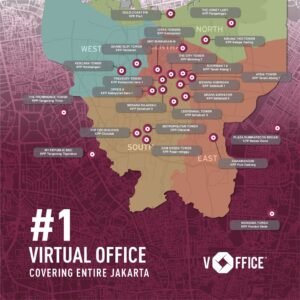
Work flexibility is another real advantage. Teams can operate from anywhere while mail and calls are still handled by a receptionist, and meeting room access is available on demand without paying for full-time space. For founders who want a legally compliant domicile without carrying the cost of a full building lease, vOffice’s Virtual Office service provides addresses across 40 or more strategic locations in Indonesia, complete with administrative support and meeting room access.
What Can a Physical Office Offer That a Virtual Office Cannot?
A physical office still wins on full control over workspace, security systems, and team culture. Businesses with daily physical operations, such as inventory storage, production, or routine in-person service, need space that can be accessed and arranged at any time.
For larger companies serving corporate clients with strict confidentiality needs, a physical office also gives tighter control over information security than a shared space. The upfront investment is bigger, but it can become a long-term asset that adds resale value to the company.
Is a Virtual Office Legally Valid for Company Registration in Indonesia?
A virtual office is legally valid as a PT’s domicile in Indonesia, under specific conditions. Article 1 paragraph 22 of PMK No. 147/PMK.03/2017 requires virtual office providers to maintain genuine physical space and real office support services, not just an empty mailing address.
The OSS RBA system, governed by Government Regulation No. 5 of 2021 on Risk-Based Business Licensing, also allows a virtual office to be used for NIB applications, as long as the location matches the Detailed Spatial Plan and sits in an office or commercial zone.
What Is the Legal Basis for Using a Virtual Office?
The following regulations form the legal basis for virtual office use in Indonesia:
- PMK No. 147/PMK.03/2017, currently in effect, defines virtual offices and sets the physical requirements for tax registration purposes.
- Law No. 40 of 2007 on Limited Liability Companies, currently in effect, requires every PT to list a complete address matching its registered domicile.
- Government Regulation No. 5 of 2021 on Risk-Based Business Licensing, currently in effect, forms the legal basis for the OSS RBA system that verifies business locations digitally.
What Happens If a Virtual Office Address Does Not Match Zoning Rules?
The biggest risk shows up during OSS verification. If a virtual office sits in the wrong zone, for example a residential area dressed up as an office, the NIB can be rejected at submission or revoked later during a field audit. Choosing a provider located in an officially zoned commercial building with complete legal documentation, as explained in this review of virtual office regulations, lowers that risk significantly.
Check out vOffice’s location options for virtual offices in Indonesia that are legally recognized for business registration:
- Rent Virtual Office Jakarta
- Rent Virtual Office Tangerang
- Rent Virtual Office Bekasi
- Rent Virtual Office Surabaya
- Rent Virtual Office Bali
- Rent Virtual Office Medan
- Rent Virtual Office Bandung
- Rent Virtual Office Batam
Want to Cut Office Costs Without Risking Legality?
vOffice, trusted by 50,000+ clients, sets up a fully legal virtual office address ready for company registration.
When Should a Business Choose a Physical Office Over a Virtual Office?
The right choice depends on how the business actually operates day to day, not just on price. Startups, digital agencies, consultants, and freelancers who rarely meet clients face to face generally benefit more from a virtual office, since it frees up early-stage capital for product development and marketing.
On the other hand, retail businesses with a physical storefront, restaurants, clinics, or manufacturers that need warehouse space and a large on-site team still require a physical office. This guide to choosing the right office for a startup can help map out where your business stands before deciding.

How Does a Hybrid Model Combine Virtual and Physical Office Space?
Many businesses end up not choosing one option exclusively. A hybrid model uses a virtual office for legal domicile and correspondence, while physical workspace is rented flexibly only when needed, for example for client meetings or weekly team sessions.
For growing businesses that are starting to need physical workspace without a long-term lease commitment, vOffice’s Serviced Office solution can complement an existing virtual office, with ready-to-use facilities across more than 40 locations.
Not Sure Which Office Mix Fits Your Business?
vOffice, present in 40+ strategic locations across Indonesia, helps you design the right virtual and serviced office combination.
Frequently Asked Questions
Can a virtual office be used for any type of business?
Not every business qualifies. A virtual office works best for service-based and digital businesses that do not store goods or meet clients in person daily, while businesses with physical operations such as production or inventory storage generally still need a physical office or separate warehouse.
How does the setup time for a virtual office compare to a physical office?
A virtual office can typically be used within days once documents and the rental contract are finalized, while a physical office takes longer to negotiate, fit out, and connect utilities before it is ready for use.
Does the virtual office cost already include tax?
It depends on each provider’s contract structure. Virtual office rental income is generally subject to Final Income Tax under Article 4 paragraph 2 or Income Tax Article 23 depending on the service type, so it is worth asking the provider for a tax breakdown before signing.
Can a business move from a virtual office to a physical office later?
Yes. Many businesses start with a virtual office to preserve early-stage capital, then move to a physical office or add a serviced office once operations and team size grow.
What is the legal risk if a virtual office address does not match zoning rules?
The biggest risk is rejection or revocation of the NIB during OSS RBA verification, since the system checks whether the business location matches the Detailed Spatial Plan before issuing a business license.
References
1. Directorate General of Taxes. (2017). Minister of Finance Regulation No. 147/PMK.03/2017 on Taxpayer Registration Procedures. Ministry of Finance of the Republic of Indonesia. Retrieved from
https://www.pajak.go.id/en/artikel/persewaan-kantor-virtual-bagaimana-pajaknya
2. Audit Board of the Republic of Indonesia. (2007). Law No. 40 of 2007 on Limited Liability Companies. JDIH BPK. Retrieved from
https://peraturan.bpk.go.id/Details/39965
3. Government of the Republic of Indonesia. (2021). Government Regulation No. 5 of 2021 on Risk-Based Business Licensing. Peraturan.go.id. Retrieved from
https://peraturan.go.id/id/pp-no-5-tahun-2021
4. Colliers Indonesia, as cited in Landbank.co.id. (2026). Office Rental Rates in Jakarta for 2026. Retrieved from
5. Easybiz, Hukumonline. (2025). Considering a Virtual Office? Check These 5 Things First. Retrieved from
https://www.easybiz.id/mau-pakai-virtual-office-cermati-dulu-5-hal-ini