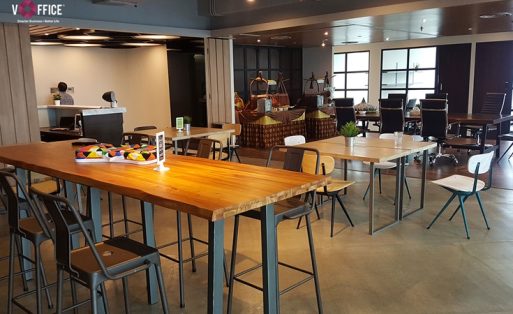

A coworking space is a shared workspace you can rent daily, weekly, or monthly alongside individuals and teams from other companies at the same location. The problem is that almost every coworking space looks appealing in its marketing photos. What separates a coworking space that actually fits from one that just looks good is how well its criteria match your day-to-day working pattern, not the interior design or the lowest price tag.
Want the full picture first, including the history and types of coworking spaces? Read vOffice’s complete guide to what a coworking space is as a companion to this article.
Key Takeaways
- What counts as “the right fit” differs for a solo freelancer, a small daily team, and a client-facing business.
- The three main desk types are hot desk, dedicated desk, and private room, each with a different price and commitment level.
- Hidden costs that get missed most often: meeting room hour quotas, printing fees, and after-hours access charges.
- A physical site visit before signing matters far more than photos on a brochure or social media.
Identify Your Team’s Work Pattern Before Comparing Coworking Spaces
The most common mistake when shopping for a coworking space is comparing prices before knowing what you actually need. A freelancer who shows up three days a week has very different requirements from an eight-person team working there every day. Start by identifying which of these three profiles fits your situation.
Solo Freelancers and Remote Workers
If you work alone and only need a focused space a few days a week, flexibility matters more than premium amenities. A day pass or hot desk is usually enough, and you avoid paying for capacity you will not use.
Small Teams With a Daily Routine
For teams of three to ten people working together every day, a dedicated desk or private room makes more sense than a hot desk. You get a guaranteed spot and can leave equipment set up instead of packing up each morning.
Client-Facing Businesses
For businesses that regularly host clients for meetings, a professional image is not optional. Check whether the available meeting rooms are presentable and large enough for the number of guests you typically bring in, not just enough for your internal team.
What Are the Main Criteria for Evaluating a Coworking Space?
Once you know your work pattern, the following criteria become far easier to judge objectively.
Location and access. A location that looks strategic on a map is not always easy to reach during rush hour. Check the actual travel time from home or your client’s office at 8 a.m., not just the distance in kilometers.
Desk type. A hot desk suits irregular use since it is the most flexible and affordable option. A dedicated desk gives you a fixed seat for daily use. A private room offers privacy comparable to a small office while still giving access to shared facilities, suiting teams that need an enclosed space without committing to a full office lease.
Meeting room facilities. Do not just check whether a meeting room exists. Ask how many hours are actually included in your monthly package.
Notes from vOffice Consultants
First-time coworking tenants tend to focus on how the lounge looks and forget to ask about the monthly meeting room quota. Once that quota runs out mid-month, they discover the overage rate can cost more than expected. Get the exact number before signing, not after an urgent client meeting.
Community fit. Some coworking spaces have communities dominated by a particular industry, such as tech startups or creative professionals. A community relevant to your industry opens up organic collaboration opportunities that formal networking events rarely match.
Data security. A shared workspace means the internet network and physical access are shared too. According to research from Next Move Strategy Consulting, cybersecurity concerns remain one of the main barriers to flexible workspace adoption, particularly for businesses handling sensitive client data. Before signing, ask whether a separate guest Wi-Fi network is available and how physical access to the workspace is managed outside peak hours.
Not Sure What a Coworking Space Actually Costs?
The vOffice team helps break down the real cost with no hidden surprises, trusted by 50,000+ clients.
How Much Does a Coworking Space Cost, and What Gets Missed?
Coworking pricing generally follows desk type. A hot desk is usually cheapest since it is shared, a dedicated desk sits in the middle, and a private room costs the most because it includes an enclosed space. Actual prices vary considerably between locations and providers, so exact figures are best confirmed directly with the provider you are considering rather than taken from a single source.
| Package Type | Best For | Lease Commitment |
|---|---|---|
| Hot Desk / Day Pass | Freelancers, irregular use | Daily to monthly |
| Dedicated Desk | Individuals or small teams, regular daily use | Monthly |
| Private Room | Small teams needing privacy and a presentable meeting space | Monthly to annual |
The costs that catch people off guard are usually not the base rental fee itself, but the extras outside the standard package: per-hour meeting room charges once your quota runs out, printing fees, or after-hours access rates. Jakarta’s recovering office market plays into this too. Colliers reported Jakarta office occupancy reaching 75.5% in the first quarter of 2026, driven by tenant relocation and expansion, which indirectly gives premium-location coworking operators more room to set higher prices.
Notes from vOffice Consultants
Many prospective tenants compare coworking spaces purely on the monthly rate listed in a brochure, then get caught off guard when extras like meeting room quotas or after-hours access show up on the first invoice. Ask for a full breakdown of what is included before comparing two offers, since the cheaper-looking number sometimes costs more once the extras are added.
How to Check a Coworking Space Before Signing a Contract
Brochure or Instagram photos rarely reflect the real condition of a coworking space. Before committing, take the following steps.
- Ask for a trial day or an in-person visit. Experience the actual working atmosphere, not just what the photos show.
- Sit at the desk and test the chair. A chair that is too low or a desk that is too high only becomes uncomfortable after hours of use.
- Check the internet during peak hours. Ask about or test the connection speed at busy times, not just during quiet periods.
- Read the cancellation terms. Know exactly how much notice you need to give if you want to end your membership.
- Ask about upgrade and downgrade options. A growing business needs the ability to scale up without heavy penalties.
For a broader look at general office comfort standards, including lighting and ergonomics, the article on how to choose a comfortable office for small companies is a useful additional reference.
Check out the various strategic locations for Coworking Spaces in Indonesia from vOffice below:
- Coworking Space Jakarta
- Coworking Space Tangerang
- Coworking Space Bali
- Coworking Space Surabaya
- Coworking Space Bekasi
- Coworking Space Medan
When Is a Coworking Space Not the Right Choice?
A coworking space is not always the best answer. If your team works entirely remotely and only needs an official business address for NIB or NPWP purposes without regular physical workspace, a virtual office is usually the more cost-effective option. If instead you need full physical space under your own company identity without sharing it with other businesses, a serviced office fits better. Read the difference between a coworking space and a serviced office to understand which one matches your current stage of business.
Market trends support this flexibility. JLL noted that Jakarta’s office market in the first quarter of 2026 showed continued positive net demand amid constrained new supply, which suggests flexible workspace options like coworking spaces are likely to stay relevant as a middle-ground solution for businesses not yet ready to commit to a long-term lease.
Ready to Try a Coworking Space That Actually Fits?
Available at 35+ strategic locations across Indonesia, ISO 9001 certified.