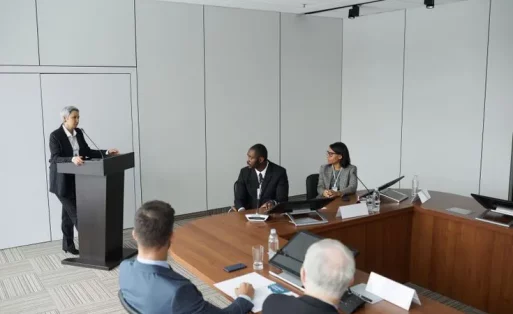

A business meeting moderator guides the discussion so participants stay with the agenda, have a fair chance to speak, and understand the outcome. The moderator manages the process, while the meeting chair or authorized executive retains decision authority.
Key Takeaways
- The moderator manages the discussion flow, speaking order, time, and connection between each agenda item and its outcome.
- An MC manages the program sequence, the chair holds authority, and the recorder documents decisions and action items.
- A useful opening states the purpose, required outcome, agenda, finish time, and decision method.
- An impartial moderator summarizes disagreement without taking sides, then returns the decision to the authorized participants.
- The closing should confirm decisions, action owners, deliverables, due dates, and unresolved questions.
Moderator, MC, Meeting Chair, and Recorder Have Different Jobs
These roles often belong to different people because each one requires a separate focus. Clear assignments let the moderator listen to participants without losing track of the process.
| Role | Primary focus | Boundary |
|---|---|---|
| Moderator | Discussion flow, participation, timing, and summaries | Does not make the final decision unless granted that authority |
| MC | Program order and transitions between segments | Does not need to facilitate the substance of the discussion |
| Meeting chair | Direction and formal approval within the chair’s authority | May delegate discussion management to the moderator |
| Recorder | Discussion points, decisions, owners, and due dates | Does not manage speaking turns |
The Association of American Medical Colleges recommends separating the facilitator, recorder, and timekeeper roles. This arrangement lets the moderator listen, summarize, and move the group to the next agenda item.
Use the vOffice guide to writing minutes of meeting for the recorder’s workflow. Teams planning a large company forum can also review the guide to preparing a town hall meeting.
Prepare the Moderator Brief Before the Meeting
The moderator needs to know the required outcome before writing an opening script. One agenda topic may end with an update, a recommendation, or a binding decision.
The American Planning Association recommends defining objectives, participant roles, discussion rules, timing, and activity formats in advance. Use a short briefing with the meeting chair to answer these questions:
- Which outcome must exist when the meeting ends?
- Who has authority to make or approve the decision?
- Will the group seek consensus, vote, or submit a recommendation?
- Which topics must finish today, and which can move to another session?
- Who will record decisions, track time, present, and operate the hybrid meeting tools?
Create an annotated run sheet for the moderator. Record the start time, objective for each topic, presenter, discussion limit, decision method, transition line, and time reserved for the summary.
Check the room from the moderator’s position. You should be able to see participants, the display, the timer, and the recorder. For a hybrid meeting, assign someone to monitor chat, questions, microphones, and remote attendees.
Notes from vOffice Consultants
Send the agenda and activity format to the venue before the meeting day. A boardroom discussion, presentation, and hybrid meeting need different layouts and display connections. Test the moderator’s seat, microphone, and timer during the technical check.
Opening Scripts for Business Meetings
A moderator’s opening gives participants a compact working map. State why the group is meeting, the output required, agenda sequence, finish time, and any speaking rules.
Weekly internal meeting
“Good morning. We will finish at 10 a.m. Our goal is to choose this week’s sales priorities and assign one owner to each follow-up. We will start with the pipeline data, discuss the two main constraints, and confirm decisions. Please keep each point concise so every function has time to contribute.”
Decision meeting
“Thank you for joining. Today we need to select a vendor for the first project phase. Procurement will explain the three evaluation criteria, then each function will state the risks it needs recorded. After the discussion, the operations director will approve the choice against those criteria. We will finish at 3:30 p.m.”
Client meeting in Indonesia
“Good afternoon, and thank you for your time. This meeting will align the business requirements, initial scope, and information still needed. We will begin with your team’s context, review the working options, and close with action owners. Is there a priority topic we should add before we begin?”
International teams should agree on the working language and explain local acronyms before the meeting. A bilingual agenda or decision slide can prevent confusion when participants use different business terminology.
Manage Time and Speaking Turns
The moderator controls time by making limits visible and warning participants before each segment ends. State the discussion limit at the start, then give a five-minute or two-minute warning.
Use direct intervention phrases that preserve the speaker’s point:
- “I will pause there so we can return to the decision we need.”
- “This issue deserves follow-up, but it sits outside today’s agenda. I will add it to the parking list.”
- “We have heard two views. I would like to invite the functions that have not described the impact yet.”
- “We have three minutes left. Can the group choose an option, or should we assign the missing data and an owner?”
AAMC guidance asks facilitators to prevent one participant from contributing too much or too little. A round of comments, directed questions, or short written reflection can bring quieter participants into the discussion.
For online meetings, Indonesia’s Central Java education quality agency distinguishes the moderator from the host. The moderator manages the discussion and questions, while the host controls participant access and technical functions. Hybrid meetings benefit from the same split.
Handle Disagreement Without Taking Sides
Impartial moderators apply the same discussion rules to each position. They can test an argument for clarity without using the role to advance a personal preference.
The Canada School of Public Service recommends impartiality, clear roles, and an agreed decision method. Use this sequence when disagreement begins to consume the meeting:
- Stop interruptions and restate the issue that requires a decision.
- Summarize each position with the participants’ terminology.
- Separate facts, assumptions, risks, and preferences.
- Return the discussion to the agreed evaluation criteria.
- Ask the authorized person to choose the next step if the group cannot agree.
A moderator might say: “I hear two concerns. Finance is focused on the spending limit, while operations is focused on implementation time. We will compare both options against the agreed weights, then the meeting chair will confirm the next step.”
Stop personal attacks, repeated points that add no information, and side conversations. Name the behavior in a calm tone, restate the meeting rule, and return to the issue.
Summarize Decisions Without Replacing the Recorder
The moderator summarizes to test shared understanding. The recorder maintains the meeting record. Canada School of Public Service guidance says summaries help groups see progress, differences, decisions, and next steps.
Use the same spoken structure at the end of each agenda item:
- Decision: the option or direction participants approved.
- Owner: one person responsible for moving the work.
- Deliverable and due date: the required output and deadline.
- Open question: missing information and the person who will obtain it.
Ask, “Is that an accurate summary?” Give the recorder time to match the notes before moving to the next topic.
Closing Script for a Business Meeting
A useful closing converts the discussion into assigned work. Participants need the decisions and actions rather than a replay of the conversation.
“Before we close, I will confirm today’s outcome. We selected option B for the pilot. Rina owns the action and will send the implementation plan by 3 p.m. Thursday. Finance will confirm the spending limit by noon Wednesday. The integration question remains open and will go to the IT team. The recorder will circulate the minutes today. The meeting ends at 11:55 a.m. Thank you.”
If the group did not reach a decision, state that status. Confirm the evidence still required, the person preparing it, the decision owner, and the date of the follow-up session.
Business Meeting Moderator Checklist
This checklist keeps the moderator focused on the discussion process without absorbing the chair’s authority or the recorder’s work.
Before the meeting
- Confirm the objective, required outcome, agenda, participants, and finish time.
- Identify the decision method and the person with approval authority.
- Assign the chair, moderator, recorder, timekeeper, and technical operator.
- Prepare the run sheet, prompts, transition lines, and parking list.
- Test the room, display, microphone, timer, and hybrid access.
During the meeting
- Open with the purpose, outcome, agenda, timing, and discussion rules.
- Manage speaking turns and invite views that have not been heard.
- Stop agenda drift and record separate issues for follow-up.
- Summarize disagreement before the group makes a decision.
- Confirm the decision, owner, deliverable, and due date for each topic.
After the meeting
- Match the spoken summary with the recorder’s notes.
- Confirm that action owners received the correct deliverables and due dates.
- Move unfinished topics to the next meeting plan.
- Review where the meeting exceeded time or missed participant input.
A suitable room helps moderators maintain eye contact, present material, take notes, and include hybrid participants. vOffice Meeting Rooms offer internet, projectors or Smart TVs, whiteboards, and presentation facilities across business districts in Indonesia. Confirm the room-specific equipment for your date.
Need a Room That Supports a Focused Discussion?
Choose presentation-ready rooms from vOffice, trusted by 50,000+ clients.
- American Planning Association. (2019). A Planner’s Guide to Meeting Facilitation. Retrieved October 13, 2026, from
https://planning.org/publications/report/9178119/ - Association of American Medical Colleges. (2010). Tools for Effective Team Meetings. Retrieved October 13, 2026, from
https://www.aamc.org/professional-development/affinity-groups/gfa/faculty-vitae/effective-team-meetings - Canada School of Public Service. (2021). Facilitation Essentials: Power and Privilege in Facilitation. Retrieved October 13, 2026, from
https://www.csps-efpc.gc.ca/tools/jobaids/power-privilege-eng.aspx - Canada School of Public Service. (2021). Facilitation Essentials: Summarizing and Synthesizing During a Meeting. Retrieved October 13, 2026, from
https://www.csps-efpc.gc.ca/tools/jobaids/summarizing-synthesizing-eng.aspx - BBPMP Central Java Province. (n.d.). Host, Co-Host, and Moderator Duties in a Zoom Meeting Room. Retrieved October 13, 2026, from
https://bbpmpjateng.kemendikdasmen.go.id/tugas-host-co-host-dan-moderator-di-ruang-meeting-zoom/ - vOffice Indonesia. (n.d.). Meeting Room. Retrieved October 13, 2026, from
https://voffice.co.id/en/services/meeting-room