
The address requirement for an export-import business is a domicile rule that has to clear two separate checks, not one. First, the location must pass zoning verification for NIB issuance through OSS. Second, the company’s identity and address must pass customs registration with the Directorate General of Customs and Excise (DJBC). A regular trading business usually only deals with the first check. Exporters and importers still have to clear a second gate before they can actually move goods through a port.
Key Takeaways
- The NIB now functions as the Importer Identification Number (API) and customs access, under Article 3 of Ministry of Trade Regulation No. 20 of 2021, but this status only becomes active once customs data is filled in through OSS.
- The current legal basis for risk-based licensing is Government Regulation No. 28 of 2025, which replaced Regulation No. 5 of 2021 as of June 5, 2025.
- Customs registration at DJBC requires business identity and address data to be verified separately from OSS, under Ministry of Finance Regulation No. 219/PMK.04/2019.
- A virtual office can be used for both NIB registration and customs registration, provided the building sits in a commercial zone under the applicable RDTR and the provider issues valid domicile documents.
Why Are Address Requirements Harder for Export-Import Businesses Than Regular Trading?

A regular domestic trading business only needs its address to pass RDTR zoning verification to get an NIB. Once the NIB is issued, the domicile question is usually settled. Export-import is different because the same address has to clear a second verification, this time inside the DJBC system, before the company can actually use its NIB as active customs access.
In practice, many new business owners assume an issued NIB automatically means they are ready to export or import. It does not. There is an extra step of entering customs activity data and selecting an API type through OSS, plus a possible follow-up check from DJBC on whether the address and business profile actually match.
What Role Does the NIB Play for an Export-Import Company?
The NIB functions as a company’s single identity number and, at the same time, replaces the old Importer Identification Number (API) and serves as the basis for customs access, as set out in Article 3(1) of Ministry of Trade Regulation No. 20 of 2021 on Import Policy and Regulation. Businesses no longer apply for a separate API document the way they did before risk-based OSS licensing.
Two types of API sit under the NIB, and picking the right one determines what kind of import activity is allowed:
- API-U (General Importer Identification Number): for businesses importing goods intended for resale to other parties.
- API-P (Producer Importer Identification Number): for businesses importing capital goods, raw materials, or auxiliary materials strictly for their own production needs. Goods imported under API-P cannot be resold to a third party.
The API type is selected directly through the Business Data Amendment menu in OSS, after the NIB is issued and the domicile address is recorded against the chosen KBLI.
How Is a Domicile Address Verified for an Export-Import NIB?
OSS automatically cross-checks the registered address against local Rencana Detail Tata Ruang (RDTR, Regional Detailed Spatial Plan) data. The address has to sit in an office, trade and services, or mixed-use zone, not a purely residential zone. For activities that involve physical storage or distribution, the system also checks the KBLI against the zone’s ITBX matrix (permitted, restricted, conditional, or prohibited).
If the region where the address is located does not yet have an RDTR integrated into OSS, businesses can apply for a Spatial Utilization Activity Conformity Approval (PKKPR) as a manual pathway, though this takes longer than automatic verification.
Notes from vOffice Consultants
Clients running export-import businesses often assume commercial zoning is the whole story. Once the KBLI touches wholesale trade of specific goods, OSS sometimes asks for additional documents based on commodity risk, not just proof of domicile. We always suggest checking the KBLI risk tier before signing an address lease, so there is no mid-process revision.
What Address Requirements Apply for Customs Registration at DJBC?
Customs registration is a separate process from NIB issuance, and importers and exporters must complete it to obtain a Customs Identification Number (NIK) and access to the CEISA 4.0 system. Under Ministry of Finance Regulation No. 219/PMK.04/2019 on Simplified Customs Registration, the required data includes the NIB, NPWP, business entity identity and address, the responsible party’s identity and address, KBLI, business legality, capital amount, and workforce size.
One detail that gets missed often: the address submitted to DJBC has to match the address on file in the deed of establishment, the NIB, and the NPWP. Even a small mismatch, such as a different RT/RW or postal code, can stall customs registration because the system flags it for extra clarification.
Once the data is complete and approved, DJBC issues an active Customs Access status reflected in the company’s NIB profile within the Indonesia National Single Window (INSW) system. Without that status active, export documents such as the PEB (Export Declaration) or import filings cannot be submitted, even if the company’s NIB is fully issued in OSS.
Which KBLI Codes Fit an Export-Import Business?
KBLI selection determines what additional documents get requested, address included, because each code carries a different risk tier. Common codes used by export-import businesses:
KBLI 46900, Wholesale Trade of Various Goods
This code fits companies trading a wide range of goods without a specific product focus, and it is often used as the primary KBLI by general trading companies.
Commodity-Specific KBLI Codes (46300 to 46500 range)
For a focused commodity, a more specific code is usually the better choice, such as KBLI 46311 for wholesale trade of agricultural products like coffee and spices, or KBLI 46411 for wholesale textile trade. A more specific KBLI tends to make follow-on licensing smoother because the relevant technical agency already has a clear SOP for that commodity.
Supporting KBLI for Warehouse Activity
If the business also stores stock in a warehouse before shipping, this activity can be registered as a supporting KBLI rather than a primary one, as long as it does not generate direct revenue and stays operationally linked to the primary trading KBLI.
Businesses can register up to 20 KBLI codes under a single NIB, but adding a KBLI after the deed is issued still requires a data amendment process in OSS and, in some cases, a notarial revision to the articles of association.
What Happens If the Business Address Does Not Meet Requirements for Export-Import?
The risk of a non-compliant address runs deeper for export-import businesses than for domestic trading, because failure can happen at two separate points.
- NIB gets frozen or revoked. If the address zoning turns out not to match the RDTR later on, OSS can freeze the NIB even if it was issued without issue at first.
- Customs registration stalls or gets rejected. A mismatch in address data between the deed, the NIB, and what is submitted to DJBC can stop the NIK and customs access process at the verification stage.
- Goods get held at the port. Without active customs access, export or import documents cannot be processed, so goods that have already arrived at a port risk being held until the administrative issue is resolved.
- PKP registration gets delayed. Export-import activity generally requires VAT-registered (PKP) status, and a field survey from the tax office can reject the application if the address does not show real business activity.
Worried Your Business Address Could Stall Customs Clearance?
vOffice, available in 40+ strategic locations across Indonesia, trusted by 50,000+ clients for business legality needs.
Legal Basis for Business Address Requirements in Export-Import
- Government Regulation No. 28 of 2025 on Risk-Based Business Licensing, currently in force as of June 5, 2025, and replacing Regulation No. 5 of 2021.
- Ministry of Trade Regulation No. 20 of 2021 on Import Policy and Regulation, as amended by Regulation No. 25 of 2022, which governs the NIB’s function as API.
- Ministry of Finance Regulation No. 219/PMK.04/2019 on Simplified Customs Registration, which sets out identity and address requirements for DJBC registration.
- Law No. 40 of 2007 on Limited Liability Companies, Article 5, which requires every PT to have a registered seat that is valid and verifiable.
Related reading: our full explainer on whether a virtual office can be used to register an NIB covers the shift from Regulation No. 5 of 2021 to Regulation No. 28 of 2025 in more detail.
How Can a Virtual Office Meet the Address Requirements for an Export-Import Business?
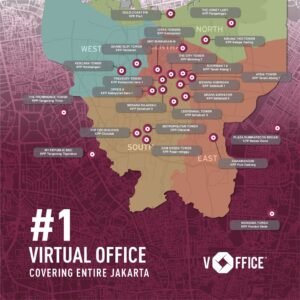
Before settling on an address, it is worth confirming that the building has already been used for an NIB under a trading KBLI that passed OSS verification, not just a paper claim of commercial zoning. For businesses that want the whole process, from deed to NIB to customs registration prep, to move without administrative friction, vOffice’s Virtual Office service provides Grade A building addresses across more than 40 strategic locations in Indonesia, including areas close to port zones such as North Jakarta, near Tanjung Priok Port.
For businesses that are not yet incorporated, or are setting up a new PT specifically for export-import, vOffice’s PT establishment service bundles the deed, NIB, NPWP, and virtual office address into a single process, so the data eventually submitted to DJBC for customs registration is consistent from day one.
Notes from vOffice Consultants
The question we hear most from trading clients is, “if my NIB is already issued, can I start importing right away?” Not necessarily. We always recommend checking the customs access status in INSW first, not just the NIB status in OSS, before signing a contract with an overseas supplier.
What Else Do You Need Besides an Address to Start an Export-Import Business?
Address is only one part of what is needed. Here is what typically runs alongside address setup:
- A deed of establishment for a PT or CV approved by the Ministry of Law and Human Rights through the SABH system, with the domicile address listed in it.
- An active corporate NPWP, since this is one of the required data points for customs registration.
- KBLI codes that match the primary commodity, including a supporting KBLI for warehousing or distribution activity where relevant.
- Customs activity data entered in OSS, along with the API type selection (API-U or API-P) that matches the business model.
- Customs registration filed with DJBC through the system integrated with OSS and SINSW, to obtain an active NIK and customs access.
Ready to Set Up Your Address and Entity for an Export-Import Business?
ISO 9001 certified, MURI Record holder for the most virtual office locations in Indonesia, address ready in under 24 hours.
References
1. Government of Indonesia. (2025). Government Regulation No. 28 of 2025 on Risk-Based Business Licensing. State Secretariat of the Republic of Indonesia. Retrieved from
https://peraturan.bpk.go.id/Details/319773/pp-no-28-tahun-2025
2. Ministry of Trade of the Republic of Indonesia. (2021). Ministry of Trade Regulation No. 20 of 2021 on Import Policy and Regulation. Retrieved from
https://peraturan.bpk.go.id/Details/204857/permendag-no-20-tahun-2021
3. Ministry of Finance of the Republic of Indonesia. (2019). Ministry of Finance Regulation No. 219/PMK.04/2019 on Simplified Customs Registration. Retrieved from
https://peraturan.bpk.go.id/Details/137074/pmk-no-219pmk042019
4. Republic of Indonesia. (2007). Law No. 40 of 2007 on Limited Liability Companies. Ministry of Law and Human Rights. Retrieved from
https://peraturan.bpk.go.id/Home/Details/38493/uu-no-40-tahun-2007
5. Jakarta Provincial Government. (2022). Jakarta Governor Regulation No. 31 of 2022 on the Regional Detailed Spatial Plan. Retrieved from
https://peraturan.bpk.go.id/Details/228166/pergub-prov-dki-jakarta-no-31-tahun-2022
6. Directorate General of Customs and Excise. (2022). Import and Customs Information. Ministry of Finance of the Republic of Indonesia. Retrieved from
https://bclampung.beacukai.go.id/layanan/impor/