

RTRW (Rencana Tata Ruang Wilayah, or Regional Spatial Plan) is the official government planning document that governs land use and spatial development across Indonesia. Under Government Regulation PP 43/2021, RTRW is defined as the result of spatial planning for a geographic area whose boundaries and systems are determined by administrative aspects. For foreign investors and business owners operating in Indonesia, understanding RTRW is not just a legal formality — it directly determines whether your business address is legally valid and whether your license applications through the OSS RBA system will be approved.
What Does RTRW Mean Under Indonesian Law?
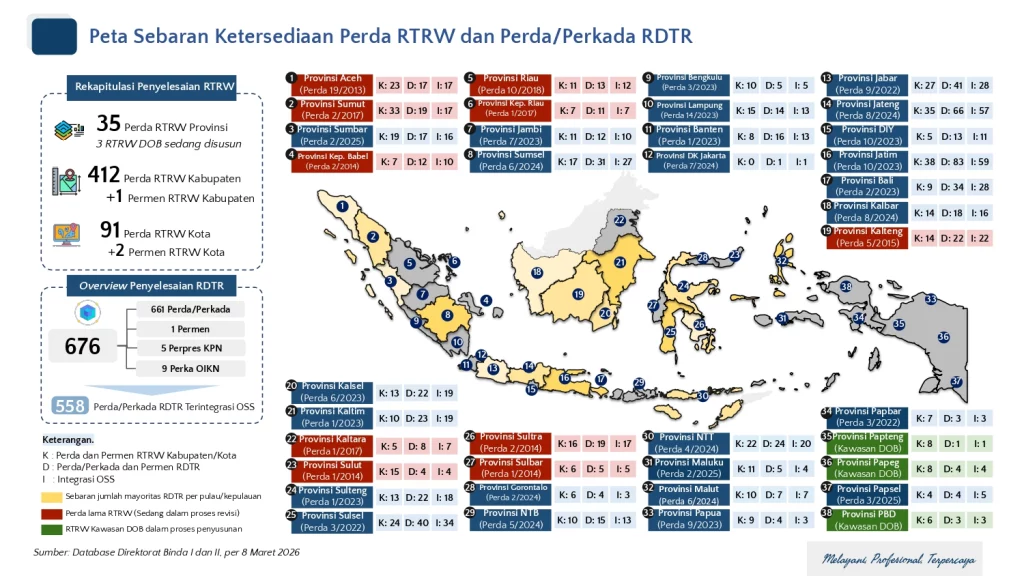
RTRW is regulated under Law No. 26 of 2007 on Spatial Planning (UU Penataan Ruang), which defines spatial planning as a system covering the planning, utilization, and control of spatial use across all aspects of national life. Every level of government in Indonesia, from the national level down to cities and regencies, maintains its own RTRW document, structured hierarchically to ensure consistency across planning layers.
In practical terms, RTRW determines which activities are permitted in a given area: commercial offices, industrial operations, residential housing, green conservation zones, and so on. Any business activity that does not align with the designated zoning faces risks at the permitting stage.
Types of RTRW in Indonesia
Indonesia’s spatial planning system is organized into three hierarchical levels, each building on the one above it:
1. National Spatial Plan (RTRWN)
The RTRWN covers the entire territory of Indonesia, including land, sea, and airspace. It establishes macro-level policy directions and strategic frameworks for national spatial utilization. The RTRWN serves as the overarching umbrella for all planning documents at lower administrative levels and has a 20-year validity period, reviewed every five years.
2. Provincial Spatial Plan (RTRWP)
The RTRWP translates national-level directions into province-specific development strategies. It covers regional resource optimization, cross-regency coordination, and sectoral development alignment. Provincial spatial plans serve as the reference point for all city and regency-level plans.
3. City/Regency Spatial Plan (RTRWK)
The RTRWK is the level most relevant for business owners. It maps out detailed zoning for cities and regencies, designating areas for commercial use, industrial activity, residential development, conservation, and public facilities. When you register a business address in Indonesia, it is this level of RTRW that determines whether your location is zoned appropriately for the intended business activity.
Key Functions of RTRW for Government and Business
RTRW serves multiple functions that directly affect how businesses operate and obtain permits in Indonesia:
- Permitting framework: RTRW forms the basis for issuing zoning regulations, business location approvals, and development permits across all levels of government.
- Land-use conflict prevention: By establishing clear zoning boundaries, RTRW prevents incompatible activities from occurring in the same area, reducing disputes between industrial, residential, and environmental interests.
- Investment planning reference: Investors use RTRW documents to assess whether their planned business activities are legally permitted at a specific location before committing capital.
- Sustainable development assurance: RTRW is designed to balance economic growth, social welfare, and environmental protection over the long term.
- Land administration basis: Land certificates and property title processes reference RTRW documents to confirm zoning compliance.
RTRW vs. RDTR: Understanding the Difference for Business Licensing
Foreign investors frequently confuse RTRW with RDTR (Rencana Detail Tata Ruang, or Detailed Spatial Plan). The distinction is critical, especially for anyone going through the OSS RBA business licensing process.
| Aspect | RTRW | RDTR |
|---|---|---|
| Scale | Macro (city/regency level) | Micro (block and parcel level) |
| Role | General land-use policy direction | Technical zoning reference per location |
| OSS Integration | Not directly integrated | Directly integrated as automatic location filter |
| Legal basis | Law No. 26/2007, PP 43/2021 | PP No. 28 of 2025 |
Since Government Regulation PP No. 28 of 2025 came into force, RDTR has become an active reference within the OSS RBA system, automatically validating business locations based on GPS coordinates rather than administrative addresses alone. RTRW, while foundational as the macro policy framework, does not function as a direct OSS filter.
Also read: Difference Between RDTR and RTRW: A Complete Guide for Businesses
Why RTRW Compliance Matters When Setting Up a Business in Indonesia
For foreign investors and entrepreneurs establishing a company in Indonesia, spatial zoning compliance touches several critical steps in the business setup process:
NIB Registration via OSS RBA
To obtain a Nomor Induk Berusaha (NIB), Indonesia’s business identification number, your business location must be verified against the applicable spatial zoning data. If your registered address sits in a residential zone rather than a commercial or office zone, the OSS system may automatically block your license application, regardless of how complete your other documents are.
KKPR and PKKPR Approval
The KKPR (Kesesuaian Kegiatan Pemanfaatan Ruang, or Location Suitability Approval) replaced the old izin lokasi system under the Job Creation Law. This approval confirms that your intended business activity aligns with the spatial zoning plan at your location. If the digital RDTR for your area has not yet been integrated into OSS, you can apply for a PKKPR as the legal alternative.
For a deeper look at the technical side of RDTR compliance, read our guide on complete RDTR regulations for 2026.
PT Company Registration with a Legal Domicile Address
When registering a PT (Perseroan Terbatas, or Limited Liability Company) in Indonesia, the domicile address stated in the notarial deed must be located in a zone that permits commercial business activity. Using a home address in a pure residential zone often leads to complications during SKDP (Surat Keterangan Domisili Perusahaan) processing and subsequent licensing steps.
Not Sure If Your Business Address Complies with Spatial Zoning?
vOffice, trusted by 50,000+ clients, provides Grade A office addresses in commercial zones across 40+ strategic locations in Indonesia, ready for OSS, NIB, and PT registration.
Practical Consequences of Non-Compliant Business Locations
Choosing a business address that does not meet RTRW and RDTR zoning requirements carries tangible operational risks that go beyond paperwork delays:
- OSS license rejection: The system automatically rejects applications where the location does not match the permitted activity type for that zone.
- Sunk costs: Rental or lease payments for locations that cannot be used as legal business addresses represent a direct financial loss.
- PKP and tax registration issues: VAT-registered status (PKP) requires a business address in an appropriate commercial or office zone. A non-compliant address can prevent PKP approval entirely.
- Government tender disqualification: Many government and private procurement processes require an active NIB, which cannot be issued without zoning compliance.
- Long-term legal exposure: Operating from a non-conforming location may expose the business to future enforcement actions as spatial planning oversight tightens nationally.
How to Verify Spatial Zoning Before Choosing a Business Location
Before committing to a business address in Indonesia, foreign investors and entrepreneurs should take these practical steps:
- Access GISTARU, the Ministry of ATR/BPN’s official Geographic Information System for spatial planning, to view zoning maps digitally.
- Use the OSS RBA RDTR Interactive tool by entering the GPS coordinates of your intended location to check what activities are permitted in that zone.
- Consult local government offices (Dinas Tata Ruang) if the digital RDTR for your target area has not yet been integrated into OSS.
- Engage a legal or corporate services provider familiar with the latest spatial zoning regulations to guide you through KKPR and PKKPR processes.
- Consider a virtual office in a verified commercial zone as a compliant and cost-effective domicile solution.
For businesses where the RDTR for a specific location is not yet available in OSS, the PKKPR mechanism provides a legal pathway to proceed with licensing. This situation is more common than many expect, particularly in developing areas outside major city centers.
Navigating RTRW compliance is one of the most practical early decisions any business owner makes in Indonesia. Getting the location right from the start avoids costly delays and legal complications later. For entrepreneurs who want a zoning-compliant business address without leasing physical office space, vOffice Virtual Office provides addresses in Grade A buildings within established commercial and business districts across 40+ locations in Indonesia, with over 20 years of regional experience across Southeast Asia.
Ready to Register Your Company with a Compliant Business Address?
vOffice, a MURI Record holder for most virtual office locations in Indonesia, ensures your business address meets every spatial zoning and licensing requirement.
Frequently Asked Questions
What is RTRW in simple terms?
RTRW (Rencana Tata Ruang Wilayah) is Indonesia’s official regional spatial plan, a government-issued planning document that determines how land and space within a given administrative territory may be used. It divides areas into designated zones such as commercial, industrial, residential, and conservation, and governs all permitting activities within those zones.
What is the difference between RTRW and RDTR?
RTRW operates at a macro level covering entire cities or regencies, while RDTR (Rencana Detail Tata Ruang) provides detailed zoning down to individual land blocks and parcels. For business licensing through OSS RBA, RDTR is the direct operational reference that validates a business location, whereas RTRW serves as the overarching policy framework above it.
Does my business address in Indonesia need to comply with RTRW?
Yes. All business activities in Indonesia must be located in a zone that permits the intended activity under the applicable RTRW and RDTR. Non-compliant locations result in automatic rejection during NIB and KKPR processing through OSS RBA.
Can a virtual office be used as a compliant business domicile under RTRW?
Yes, provided the virtual office provider is located in a building within a commercial or office zone as defined by the local RTRW and RDTR. Grade A office buildings in established CBDs typically meet this requirement and are routinely accepted for NIB, PT registration, and PKP purposes.
How long is an RTRW valid?
Each RTRW document is valid for 20 years, with mandatory reviews conducted every five years to accommodate changes in development needs, population growth, and economic conditions.
What happens if a business operates from a non-compliant location?
Operating from a location that does not match its designated zone under RTRW can lead to rejection of business licenses and NIB, inability to obtain PKP status, exclusion from government tenders, and potential future enforcement action as spatial compliance oversight intensifies nationally.
References
1. Ministry of Law and Human Rights, Republic of Indonesia. (2007). Law No. 26 of 2007 on Spatial Planning. JDIH Kemenkumham. Retrieved from
https://jdih.kemenkumham.go.id
2. Secretariat of State, Republic of Indonesia. (2021). Government Regulation No. 43 of 2021 on Resolution of Spatial Inconsistencies. JDIH Setneg. Retrieved from
https://jdih.setneg.go.id
3. Ministry of Finance, Republic of Indonesia. (2021). Legal Definition: Rencana Tata Ruang Wilayah. JDIH Kemenkeu. Retrieved from
https://jdih.kemenkeu.go.id/kamus-hukum/rencana-tata-ruang-wilayah
4. Ministry of Investment/BKPM, Republic of Indonesia. (2025). OSS RBA: Risk-Based Business Licensing System. OSS Indonesia. Retrieved from
https://oss.go.id
5. Ministry of Agrarian Affairs and Spatial Planning/BPN. (2021). Ministerial Regulation No. 11 of 2021 on Spatial Planning Guidelines. ATR/BPN. Retrieved from
https://www.atrbpn.go.id
6. Secretariat of State, Republic of Indonesia. (2025). Government Regulation No. 28 of 2025 on Risk-Based Business Licensing. JDIH Setneg. Retrieved from
https://jdih.setneg.go.id