

KLHS RDTR is a mandatory Strategic Environmental Assessment (SEA) that Indonesian regional governments must complete before a Detailed Spatial Plan (RDTR) can be legally enacted. The document ensures every spatial zoning decision has been evaluated against environmental carrying capacity, ecosystem services, and sustainable development principles. For foreign investors and business owners operating in Indonesia, KLHS RDTR is more than a bureaucratic formality. The quality of this assessment directly determines the legal strength of the RDTR governing your business location, and therefore the smoothness of your permit process through the OSS RBA (Online Single Submission) system.
Understanding KLHS and RDTR Separately
KLHS stands for Kajian Lingkungan Hidup Strategis, translated as Strategic Environmental Assessment (SEA). It is defined by Law No. 32 of 2009 on Environmental Protection and Management as a systematic, comprehensive, and participatory analysis process that ensures sustainable development principles are embedded in every government policy, plan, or program (KRP) that may have environmental impact. Indonesian law mandates both central and regional governments to conduct KLHS before enacting major planning documents, including RDTR.
The three core values guiding KLHS are interdependency, equilibrium, and justice. These principles ensure that development decisions are economically viable, ecologically safe, and socially equitable at the same time.
RDTR (Rencana Detail Tata Ruang) is Indonesia’s most granular level of spatial planning. It operates at the city or regency level and regulates land use zoning down to individual blocks and sub-zones. While the broader RTRW (Regional Spatial Plan) sets macro land use direction, RDTR specifies exactly which business activities are permitted at which precise locations, based on KBLI business classification codes.
KLHS RDTR is the application of the Strategic Environmental Assessment specifically to the RDTR drafting process. It functions as an environmental filter embedded into spatial planning, ensuring that zoning designations, intensity regulations, and land use assignments within the RDTR are grounded in the actual environmental carrying capacity of the area.
The legal obligation to conduct KLHS in RDTR preparation is established under Law No. 32/2009 and further detailed in Government Regulation No. 46 of 2016 on KLHS implementation, as well as Ministry of ATR/BPN Regulation No. 5 of 2022 on the integration of KLHS into spatial plan preparation. The KLHS process runs in parallel with RDTR drafting, and the resulting recommendations must be incorporated into the spatial plan before it can proceed to legal validation and enactment.
For a practical guide on checking RDTR compliance, refer to our guide on How to Properly Check RDTR.
Setting Up a PT Company in Indonesia and Unsure About RDTR Zoning?
vOffice, with 13+ years in Indonesia, handles PT registration end-to-end including RDTR-compliant address selection and OSS RBA licensing.
Functions of KLHS in RDTR Preparation
KLHS is not a supplementary attachment to the RDTR. It plays a substantive role in shaping the quality and legal defensibility of the spatial plan.
1. Integrating Environmental Considerations into Zoning
KLHS ensures that zoning designations, whether for residential, commercial, industrial, or green areas, reflect the actual ecological characteristics and limitations of the land. Without this assessment, zones could be established in flood-prone or ecologically sensitive areas, creating long-term liabilities for local governments and investors alike.
2. Providing Science-Based Decision Making
Through the analysis of six environmental dimensions, namely carrying capacity, ecosystem services, natural resource efficiency, disaster risk, climate change risk, and biodiversity, KLHS generates scientific data that underpins every zoning regulation. Decisions embedded in the RDTR become measurable, verifiable, and publicly accountable.
3. Enabling Public Participation and Transparency
KLHS preparation requires the involvement of diverse stakeholders, including academics, community groups, industry representatives, and local residents. This participatory process not only enriches the analysis but also builds public legitimacy for the resulting RDTR.
4. Creating Legal Certainty for Investment
An RDTR grounded in a validated KLHS carries stronger legal standing. For investors and business owners, this means greater confidence that the zoning applicable to your chosen location cannot be easily challenged or invalidated on environmental grounds. A deficient or absent KLHS can become a legal vulnerability that puts the RDTR, and consequently all permits issued under it, at risk.
5. Enabling RDTR Validation and OSS Integration
Under Ministry of ATR/BPN Regulation No. 5 of 2022, a quality-assured KLHS is a prerequisite for submitting an RDTR for legal validation. The mayor or regent submits a KLHS validation request to the governor, which must be processed within 10 business days of receiving a complete application. Only after this validation can the RDTR be integrated into Indonesia’s OSS RBA licensing system.
The KLHS RDTR Preparation Process: 11 Key Stages
Based on Government Regulation No. 46 of 2016 and Minister of Environment and Forestry Regulation P.69/MENLHK/2017, KLHS RDTR preparation involves 11 integrated stages running parallel to the RDTR drafting process.
Stage 1: Establishing the KLHS Working Group
Regional governments form a KLHS Working Group (Pokja KLHS), which may be consolidated with the RDTR drafting team under a single official decree to streamline coordination and avoid process duplication.
Stage 2: Identifying Sustainable Development Issues
The team identifies strategic environmental issues relevant to the planning area, such as flood vulnerability, water availability, land degradation, or pressure on protected ecosystems.
Stage 3: Prioritizing Strategic Issues
From all identified issues, the team determines which are most critical to long-term sustainable development in the area, forming the analytical core of the KLHS.
Stage 4: Identifying High-Impact RDTR Content
The team analyzes which RDTR components, particularly spatial structure and land use plans, carry the greatest potential to negatively affect environmental conditions.
Stage 5: Impact Analysis Against Six Environmental Dimensions
Formal analysis covers all six KLHS dimensions: carrying capacity, ecosystem services, resource efficiency, disaster risk, climate change risk, and biodiversity. This is the analytical core of the entire KLHS process.
Stage 6: Compiling the KLHS Assessment
Results are compiled into a comprehensive assessment documenting current environmental conditions and projected impacts under various development scenarios outlined in the RDTR draft.
Stage 7: Formulating Policy Alternatives
Where significant negative impacts are identified, the team proposes alternative spatial arrangements: adjusted zone boundaries, reduced development intensity, or additional buffer zones.
Stage 8: Drafting Recommendations
The KLHS team issues binding recommendations that must be integrated into the RDTR content and maintained throughout all subsequent deliberation stages of the draft regional regulation.
Stage 9: Quality Assurance
Independent quality review is conducted in phases to verify that all KLHS procedures meet the standards prescribed by applicable regulations.
Stage 10: Documentation
All processes and findings are comprehensively documented as part of the RDTR’s official preparation record, accessible to the public.
Stage 11: Validation
The regional government submits the quality-assured KLHS for official validation. This validated document is a legal prerequisite for the RDTR to be enacted and subsequently integrated into the OSS RBA system.
KLHS RDTR vs. KLHS RTRW: Key Differences
KLHS is conducted at every level of Indonesia’s spatial planning hierarchy. The differences between KLHS RDTR and KLHS RTRW relate to analytical scale, scope, and validation authority.
| Aspect | KLHS RTRW | KLHS RDTR |
|---|---|---|
| Analytical scale | Macro, full regency/city | Detailed, per district/BWP |
| Parent document | RTRW (Regional Spatial Plan) | RDTR (Detailed Spatial Plan) |
| KLHS validation | Governor submits to Ministry of LHK | Mayor/Regent submits to Governor |
| OSS relevance | Indirect | Direct (RDTR integrated into OSS RBA) |
For business owners, KLHS RDTR is the more directly relevant document because it underpins the zoning rules that OSS RBA applies to your specific business location. To understand how urban planning areas are structured within RDTR, see our guide on RDTR regulations for 2026.
How KLHS RDTR Affects Your Business Licensing in Indonesia
The KLHS RDTR process may seem distant from day-to-day business concerns. In practice, its outputs shape the system that decides whether your NIB gets issued or rejected.
A Validated KLHS Enables Automatic KKPR Confirmation
When an RDTR is built on a valid KLHS and integrated into OSS RBA, the Spatial Activity Compliance Confirmation (KKKPR) process becomes automatic. A business location in a compliant zone receives instant confirmation, and NIB issuance proceeds without manual intervention. Under Ministry of Investment Regulation No. 5 of 2025, this automated KKPR mechanism has significantly reduced wait times that previously took weeks through manual review processes.
Non-Compliant Locations Are Rejected Without Exception
Conversely, if your chosen address falls in a zone that prohibits your KBLI activity, OSS RBA rejects the application automatically, without manual review options. This is a systemic, non-negotiable outcome. Many foreign investors and new business owners only discover this after signing lease agreements or purchasing property. Correcting course at that stage is significantly more expensive than applying an RDTR-first approach from the beginning.
Virtual Offices Are Not an RDTR Problem, If the Address Is Correct
A common misconception among foreign entrepreneurs is that virtual offices create RDTR complications. The determining factor is not the office format but the zoning of the building where the address is registered. A virtual office address located in a building within a legally designated commercial zone, with valid building permits, is fully eligible as a PT domicile address for OSS RBA purposes. The approach that removes this uncertainty is choosing an address that has already been verified as RDTR-compliant from the outset.
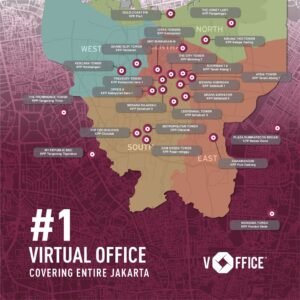
For investors and business owners who want to operate in Indonesia with full legal certainty from day one, vOffice Virtual Office provides addresses in Grade A buildings across verified commercial zones at 40+ locations throughout Indonesia, including 25+ in Jakarta. Every vOffice address is positioned in areas aligned with applicable RDTR zoning and integrated with OSS RBA, removing the guesswork from your business setup process entirely.
Concerned About RDTR Zoning Compliance for Your Business Address?
All vOffice locations are in Grade A commercial zone buildings, trusted by 50,000+ clients to get OSS RBA right from the start.
Frequently Asked Questions
What is the difference between KLHS and AMDAL in Indonesia?
KLHS (Strategic Environmental Assessment) operates at the policy and planning level, such as RDTR or RTRW, and is conducted before the planning document is enacted. AMDAL (Environmental Impact Assessment) applies at the individual project level and is required before a specific business activity begins. Both are environmental protection instruments that operate at different levels of the regulatory hierarchy.
Is KLHS mandatory for all RDTRs in Indonesia?
Yes. Article 15 of Law No. 32 of 2009 mandates that all government bodies, both central and regional, must conduct KLHS whenever preparing policies, plans, or programs with potential environmental impact. This includes every RDTR. An RDTR without a validated KLHS cannot be legally enacted and therefore cannot be integrated into OSS RBA for business licensing purposes.
How do I know if the RDTR in my business area has a valid KLHS?
RDTRs that have completed the KLHS validation process are integrated into the OSS RBA system digitally. You can check whether the RDTR covering your business location is available by entering your address coordinates into the RDTR Interactive feature at oss.go.id. If the system returns zoning data, the RDTR in that area has been validated and integrated.
What happens if the RDTR in my area does not yet have a validated KLHS?
If an area’s RDTR has not yet been integrated into OSS RBA because its KLHS process or validation is incomplete, automated licensing is not available. Business owners can apply for a Persetujuan KKPR (PKKPR) as a legal alternative, which involves a manual evaluation process by the relevant government authorities under PP No. 28 of 2025.
Can a virtual office address in Indonesia be used as a PT domicile if the area has a valid RDTR?
Yes. The determining factor is whether the building where the virtual office is registered is located within a commercially zoned area as defined by the applicable RDTR, and whether the building holds valid permits. If both conditions are met, a virtual office address is fully valid as a PT company domicile for OSS RBA submission. Office format is not the relevant criterion; zoning compliance is.
How long does the KLHS RDTR preparation process take?
Duration varies based on regional complexity and data readiness. The process runs in parallel with RDTR drafting. Once quality assurance is complete, the KLHS validation request submitted to the governor must be processed within 10 business days of receiving a complete application. Total timeline from start to integration into OSS can range from months to over a year depending on the regional government’s capacity and coordination.
References
1. Pemerintah Republik Indonesia. (2009). Undang-Undang Nomor 32 Tahun 2009 tentang Perlindungan dan Pengelolaan Lingkungan Hidup. Sekretariat Negara RI. Diperoleh dari
https://jdih.menlhk.go.id
2. Pemerintah Republik Indonesia. (2016). Peraturan Pemerintah Nomor 46 Tahun 2016 tentang Tata Cara Penyelenggaraan Kajian Lingkungan Hidup Strategis. Kementerian Lingkungan Hidup dan Kehutanan RI. Diperoleh dari
https://jdih.menlhk.go.id
3. Kementerian Agraria dan Tata Ruang/BPN. (2022). Peraturan Menteri Agraria dan Tata Ruang/BPN Nomor 5 Tahun 2022 tentang Tata Cara Pengintegrasian Kajian Lingkungan Hidup Strategis dalam Penyusunan Rencana Tata Ruang. Kementerian ATR/BPN RI. Diperoleh dari
https://tataruang.atrbpn.go.id
4. Kementerian Lingkungan Hidup dan Kehutanan. (2017). Peraturan Menteri LHK Nomor P.69/MENLHK/SETJEN/KUM.1/12/2017 tentang Pelaksanaan PP Nomor 46 Tahun 2016 tentang Penyelenggaraan KLHS. KLHK RI. Diperoleh dari
https://jdih.menlhk.go.id
5. Pemerintah Republik Indonesia. (2025). Peraturan Pemerintah Nomor 28 Tahun 2025 tentang Penyelenggaraan Perizinan Berusaha. Sekretariat Negara RI. Diperoleh dari
https://jdih.setneg.go.id
6. Direktorat Jenderal Tata Ruang, Kementerian ATR/BPN. (2021). Integrasi KLHS dalam Penyusunan Rencana Tata Ruang: Pembahasan Koordinasi Teknis. Kementerian ATR/BPN RI. Diperoleh dari
https://tataruang.atrbpn.go.id/Berita/Detail/4054
7. Dinas Lingkungan Hidup Kabupaten Kulon Progo. (2022). Validasi KLHS dalam Penyusunan Rencana Tata Ruang. DLH Kulon Progo. Diperoleh dari
https://dlh.kulonprogokab.go.id/detil/1135/validasi-klhs-dalam-penyusunan-rencana-tata-ruang