
If you are setting up a business in Indonesia and have encountered the term BWP during the licensing process, this article explains exactly what it means and why it matters for your company’s domicile address. BWP stands for Bagian Wilayah Perkotaan, which translates roughly as “Urban Area Section.” It is the primary planning unit within Indonesia’s Rencana Detail Tata Ruang (RDTR), or Detailed Spatial Plan.
Understanding BWP is not just academic. Since Government Regulation (PP) No. 28 of 2025 integrated RDTR data into the OSS RBA business licensing system, every business address in Indonesia is automatically cross-checked against the zoning map of the relevant BWP. If the address falls in the wrong zone, the NIB (Business Identification Number) simply will not be issued, regardless of how complete your other documents are.
This guide explains the BWP concept, its hierarchical structure, and the practical steps you need to take to ensure your office address is compliant.
Also read: Complete Guide to the Latest RDTR Regulations
What Is BWP in RDTR?
Under the Minister of Public Works Regulation No. 20/PRT/M/2011 and the subsequent Minister of ATR/BPN Regulation No. 16 of 2018, a BWP is defined as a part of a regency or city (or its strategic area) that requires detailed spatial planning through RDTR, as directed by the city’s higher-level spatial plan (RTRW).
In practical terms, think of it this way: if the RTRW is a city-wide zoning map at a broad scale, RDTR zooms into a specific section of that city, the BWP, and plans it in fine detail at a 1:5,000 map scale. This level of detail goes down to individual blocks and land parcels, determining precisely what activities are permitted at each location.
Each BWP typically covers 2,500 to 3,000 hectares. A single city may have multiple RDTRs, one for each BWP.
For a broader understanding of how spatial zones work in Indonesia’s RDTR system, see our guide on the latest RDTR regulations for 2026.
The Three-Tier Hierarchy: BWP, Sub BWP, and Block
RDTR organizes space into three nested planning units. Understanding this hierarchy is essential for anyone choosing a business address in Indonesia.
BWP (Bagian Wilayah Perkotaan)
The BWP is the broadest unit, encompassing the entire planning area covered by a single RDTR document. At this level, the government establishes the overall spatial goals, the structure plan (distribution of service centers and infrastructure), and the land-use pattern (which zones go where). A BWP can correspond to an administrative district, a functional zone such as a central business district, or a strategic development area.
Sub BWP (Sub Bagian Wilayah Perkotaan)
A Sub BWP is a subdivision of the BWP, delineated by physical boundaries such as roads, rivers, or railway lines, and consisting of several blocks. Under Indonesian spatial planning regulations, Sub BWP is equivalent in legal meaning to a “zoning subdistrict” (subzona peruntukan) as defined in Government Regulation No. 15 of 2010. At this level, the government identifies which Sub BWPs are prioritized for development or tighter land-use control.
Block (Blok)
The block is the smallest planning unit in RDTR. Each block is bounded by physical features and is where zoning regulations operate at the most granular level. Zoning surveys at the block level can go down to individual parcels of 400 m² or even 100 m². It is at the block level that the ITBX matrix specifies exactly which business activities are permitted, restricted, conditionally allowed, or prohibited.
| Planning Unit | Definition | Key Function |
|---|---|---|
| BWP | The full planning area of a single RDTR document | Sets spatial goals, structure plan, and land-use pattern |
| Sub BWP | A physically-bounded subdivision of the BWP, made up of blocks | Determines priority zones and sub-district land use |
| Block (Blok) | The smallest unit within a Sub BWP | Where the ITBX zoning matrix is applied per land parcel |
Why BWP Matters for Business Licensing in Indonesia
For foreign investors, startup founders, and UMKM (small-to-medium enterprise) owners, the BWP zoning system has direct consequences for how you register your company and where you can legally operate.
Automatic Location Validation via OSS RBA
Under the RDTR-integrated OSS RBA system, when you apply for an NIB or KKPR (Spatial Use Conformity), the system reads the geographic coordinates of your business address and automatically matches them against the zoning data of the BWP covering that location. This is not a manual check; it is an automated spatial query. If your KBLI (business activity code) is not permitted in the zone your address falls under, the application is rejected instantly.
Residential Zones and Commercial Zones Are Strictly Separated
One of the most common mistakes made by new business owners is using a home address in a residential zone (R-zone) as a company domicile. RDTR explicitly separates residential and commercial zones within a BWP. Commercial activities are generally only permitted in trade and services zones (K-zones), office zones, or mixed-use zones. Using a residential address for a commercial business leads to automatic KKPR rejection in OSS.
The ITBX Matrix Determines Activity-Level Compatibility
Even within a commercial zone, not all business activities are automatically permitted. Each block has an ITBX matrix that classifies activities as allowed (I), restricted (T), conditionally permitted (B), or prohibited (X). When you register a KBLI under your company, OSS cross-references that KBLI against the ITBX matrix of your block. This is why two addresses in the same general area can produce different licensing outcomes depending on their exact block zoning.
Not Sure if Your Address Is Zoning-Compliant?
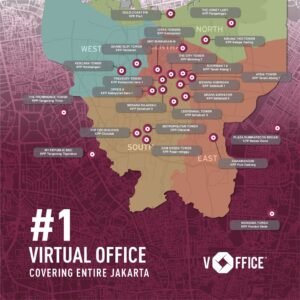
vOffice provides virtual office addresses in Grade A buildings within designated commercial zones at 40+ locations across Indonesia, backed by 20+ years of experience in Southeast Asia.
Virtual Offices and BWP Compliance: What Foreign Investors Need to Know
A common question from foreign investors and expat entrepreneurs setting up a PT PMA (foreign-owned limited liability company) or PT (domestic company) concerns virtual offices. The short answer: virtual offices are not inherently problematic under Indonesian RDTR regulations. The determining factor is always the zone of the building where the virtual office is located within the applicable BWP.
As long as the virtual office building sits within a commercial or trade-and-services zone in the RDTR zoning map, its address is legally valid for company domicile registration, NIB issuance, and related administrative purposes. The issue is not the format of the office, it is the zoning of its location.
This is particularly relevant in Jakarta, where the RDTR (based on Provincial Regulation No. 1 of 2014 and updated through subsequent regulations) strictly zones areas into commercial, residential, green belt, and other categories. Virtual office providers operating in Grade A buildings within the Central Business District (CBD) of Jakarta sit within zones specifically designated for office and commercial use, making them fully compliant with RDTR requirements.
For businesses looking to establish a PT PMA or PT without a physical office, vOffice’s virtual office service provides addresses in Grade A commercial buildings across 40+ locations in Indonesia, all verified within compliant commercial zones under the applicable RDTR.
How to Check the BWP Zone of Your Business Address
The Indonesian government provides several official platforms for verifying the RDTR zone of any given address:
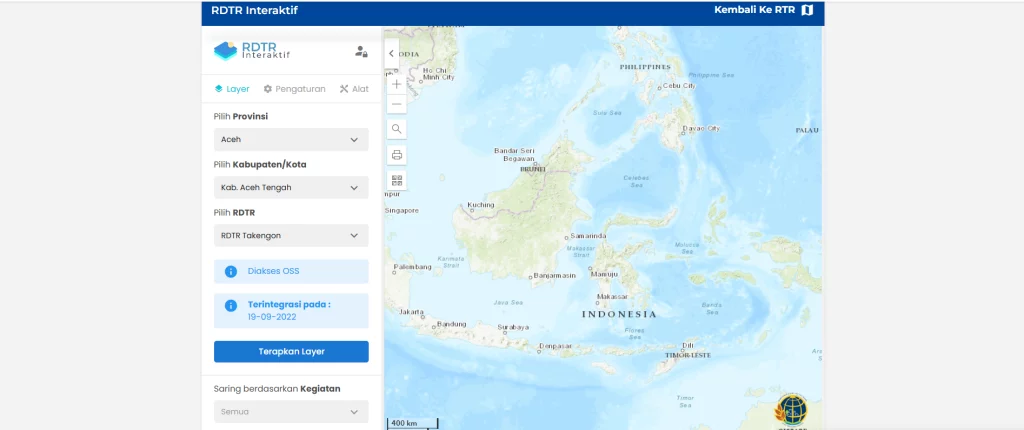
- OSS Interactive RDTR (oss.go.id): The primary official channel, directly integrated with the licensing system. Enter the coordinates of your business location to see which zone and Sub BWP it falls under, and which activities are permitted.
- ATR/BPN GeoPortal (geoservices.atrbpn.go.id): The Ministry of ATR/BPN’s spatial data portal, which displays RDTR maps for regions where digital integration is available.
- Smart RDTR Jakarta (specific to DKI Jakarta): A dedicated platform for checking Sub BWP zoning within Jakarta’s administrative boundaries.
As of December 2025, 539 RDTRs have been integrated into OSS digitally. For areas where RDTR integration is not yet available, the PKKPR (Persetujuan Kesesuaian Kegiatan Pemanfaatan Ruang) process serves as the official alternative route for licensing. This is a manual review mechanism administered by the relevant government authority.
Practical Example: How BWP Affects Company Registration
To make this concrete, consider the following scenario common in Indonesian business registration.
An entrepreneur registers a technology consultancy company in a mid-sized Indonesian city. The city’s RDTR divides the central urban area into one BWP, which contains four Sub BWPs. Sub BWP A covers the city’s main commercial corridor and is zoned primarily as K-1 (large-scale trade and services). Sub BWP B covers the adjacent residential neighborhoods, zoned R-2 and R-3 (medium and high-density housing).
If the entrepreneur uses a serviced office or virtual office address located in a Grade A commercial building within Sub BWP A, the OSS system automatically confirms KKPR and issues the NIB. If the entrepreneur uses their home address in Sub BWP B, the OSS system rejects the KKPR application automatically, regardless of whether the home is a house or an apartment unit in a modern complex.
This scenario repeats daily across Indonesia. The solution is straightforward: start with zoning, then choose the address. For businesses that want this handled correctly from day one, vOffice PT company registration services include guidance on selecting a domicile address that is fully compliant with the applicable RDTR before the application is submitted.
Ready to Set Up Your Business with a Compliant Address?
vOffice is trusted by 50,000+ clients and operates in Grade A commercial buildings across Indonesia, ensuring your domicile address passes RDTR validation in OSS RBA from the start.
Frequently Asked Questions
What does BWP stand for in Indonesian spatial planning?
BWP stands for Bagian Wilayah Perkotaan, meaning “Urban Area Section.” It is the primary planning unit in Indonesia’s RDTR (Rencana Detail Tata Ruang, or Detailed Spatial Plan), representing the full geographic area covered by a single RDTR document.
How is BWP different from Sub BWP?
A BWP is the entire planning area of one RDTR document, while a Sub BWP is a smaller subdivision within the BWP, physically bounded by features like roads and rivers, and composed of several blocks. Sub BWP is legally equivalent to a zoning subdistrict in Indonesia’s spatial planning framework.
Does every city in Indonesia have an RDTR with defined BWPs?
Not yet. As of December 2025, only 539 RDTRs have been digitally integrated into the OSS licensing system. The government is actively accelerating this integration. For areas without an integrated RDTR, businesses can apply for a PKKPR (manual spatial conformity approval) as an alternative route.
Can I use a virtual office address for my PT PMA if it is in a commercial zone?
Yes. A virtual office address in a building located within a commercial or trade-and-services zone under the applicable RDTR is legally valid for PT PMA registration, NIB issuance, and related purposes. The legality depends on the zoning of the building’s location, not on whether the office format is physical or virtual.
What happens if my business address does not match the BWP zone?
The OSS RBA system will automatically reject the KKPR application, preventing the NIB from being issued. This occurs regardless of how complete the rest of your company documents are. The quickest solution is to switch to an address located in a zone that permits your specific business activity (KBLI).
How do I verify the RDTR zone for a specific address in Indonesia?
Use the Interactive RDTR feature on the OSS portal (oss.go.id). Enter the geographic coordinates of the address, and the system will show the applicable zone, permitted activities, and the ITBX matrix for that location. For Jakarta specifically, the Smart RDTR platform provides an additional verification channel.
References
1. Ministry of Public Works, Republic of Indonesia. (2011). Regulation No. 20/PRT/M/2011 on Guidelines for Preparing Detailed Spatial Plans and Zoning Regulations. Retrieved from
https://pemerintahan.surabaya.go.id/basis-data/storage/regulations/1643242337.pdf
2. Ministry of ATR/BPN, Republic of Indonesia. (2018). Regulation No. 16 of 2018 on Guidelines for Preparing RDTR and Zoning Regulations for Regencies and Cities. Retrieved from
https://www.atrbpn.go.id/Publikasi/Peraturan-Perundangan
3. Ministry of ATR/BPN, Republic of Indonesia. (2021). Regulation No. 11 of 2021 on Procedures for Preparing, Reviewing, Revising, and Issuing Approval for RDTR. Retrieved from
https://www.atrbpn.go.id/Publikasi/Peraturan-Perundangan
4. Government of Indonesia. (2010). Government Regulation No. 15 of 2010 on Implementation of Spatial Planning. Retrieved from
https://jdih.setneg.go.id/viewpdfperaturan/PP152010
5. Government of Indonesia. (2025). Government Regulation No. 28 of 2025 on Implementation of Spatial Planning. Retrieved from
https://jdih.setneg.go.id
6. House of Representatives, Republic of Indonesia. (2007). Law No. 26 of 2007 on Spatial Planning. Retrieved from
https://jdih.setneg.go.id/viewpdfperaturan/UU262007
7. Wikipedia Bahasa Indonesia. (2024). Rencana Detail Tata Ruang. Retrieved from
https://id.wikipedia.org/wiki/Rencana_Detail_Tata_Ruang