
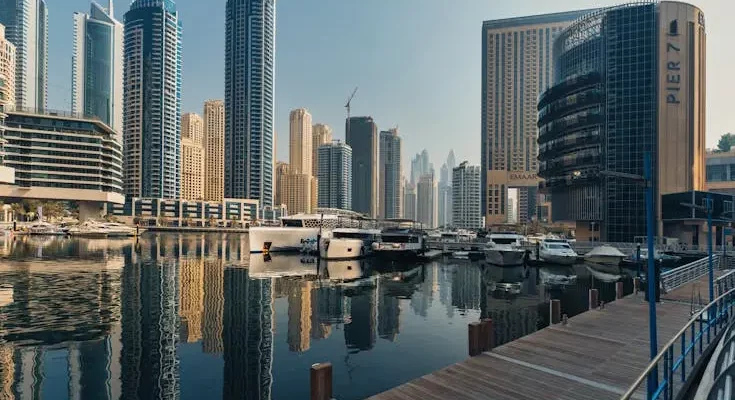
Offshore company formation in Dubai is not a shortcut to tax-free profits. It is a specific legal structure, registered in one of two UAE offshore jurisdictions, designed for international business activity, asset holding, and investment management rather than active trading within the UAE. Two jurisdictions handle the vast majority of UAE offshore registrations: JAFZA (Jebel Ali Free Zone Authority) in Dubai and RAKICC (RAK International Corporate Centre) in Ras Al Khaimah. They serve different purposes and have different cost profiles.
This guide covers what makes each one distinct, how offshore compares to a Free Zone LLC or Mainland LLC, and the practical scenarios where offshore is genuinely the better choice. The content is informational only and does not constitute legal or tax advice. UAE regulations are subject to change; verify current requirements with a qualified professional before making structural decisions.
What Is an Offshore Company in the UAE?

A UAE offshore company is a legal entity registered in an offshore jurisdiction rather than on the mainland or in a standard free zone. It can hold assets internationally, receive dividends from subsidiaries, and conduct cross-border transactions. What it cannot do is carry out commercial activity within the UAE domestic market or hire employees who work physically in the UAE.
Compared to a Free Zone LLC: no physical office or Flexi Desk is required, UAE residency visas are not available through offshore registration alone, and annual operational costs are typically lower. The tradeoff is a significant restriction on UAE-based activity.
Read Also: Business Guide in Dubai: Expansion Opportunities for International Entrepreneurs
Jebel Ali Offshore (JAFZA): The Only Offshore That Can Hold Dubai Property
JAFZA manages the Middle East’s largest free zone and also issues offshore company licences for businesses that want a Dubai legal presence without local operations. Its defining advantage over all other UAE offshore jurisdictions: only JAFZA-registered offshore companies are permitted by the Dubai Land Department (DLD) to purchase property in Dubai. That rule has been in place since January 2011.
If holding Dubai real estate through a corporate structure is part of your plan, JAFZA is the only offshore option that allows it. Setup costs are higher than RAKICC, which reflects both Dubai’s premium market position and the additional regulatory framework around DLD compliance.
Key Features of JAFZA Offshore
JAFZA offshore companies allow 100% foreign ownership with no local sponsor required. No physical office obligation. Can open a corporate bank account in the UAE, subject to the bank’s own approval process. Strong privacy protections for shareholders. Higher annual fees than RAKICC.
RAKICC: The Most Cost-Efficient UAE Offshore for International Holding
RAKICC is the offshore registration authority in Ras Al Khaimah, an emirate north of Dubai. It consistently ranks as one of the most affordable offshore jurisdictions in the Gulf region. That price advantage does not come from weaker regulation; it reflects a different use case.
RAKICC does not issue trade licences and is not designed for companies that want to conduct active business in the UAE. For holding structures, cross-border investment management, or owning shares in operating companies elsewhere in the world, RAKICC is a well-established and widely used option. No minimum capital is required. No physical presence in the UAE is needed. The registration process can complete in a matter of working days.
Key Features of RAKICC
Lower setup and annual renewal costs than JAFZA. 100% foreign ownership. Corporate bank accounts are possible with complete documentation, though UAE banks are increasingly rigorous in their verification process. Cannot hold property in Dubai (RAK property is possible under certain conditions). Best suited to holding companies, asset management, and international investment structures.
Offshore vs. Free Zone vs. Mainland: Side-by-Side Comparison
The table below compares the three main UAE business structures on the dimensions that matter most to international founders. This is a general guide; specific details vary by jurisdiction and business activity type. Always verify with a qualified adviser before making a final decision.
| Factor | Offshore (JAFZA / RAKICC) | Free Zone LLC | Mainland LLC |
|---|---|---|---|
| Foreign Ownership | 100% | 100% | 100% (most sectors, post-2021 reform) |
| Trade Within UAE | Not permitted | Within free zone and internationally | Across all UAE |
| Dubai Property Ownership | JAFZA: Yes; RAKICC: No | Limited | Yes |
| UAE Residency Visa | Not directly available | Available | Available |
| Corporate Tax | 0% on international income (verify with tax adviser) | 0% on qualifying income | 9% on net profit above AED 375,000 |
| Physical Office Required | No | Flexi Desk or office required | Office + EJARI required |
| UAE Bank Account | Possible, subject to bank approval | Yes | Yes |
| Estimated Setup Cost | Lower (especially RAKICC) | From USD 3,267 (vOffice package) | From USD 10,209 (vOffice package) |
| Best Suited For | Holding, asset protection, international investment | Global invoicing, UAE operations base, residency | Active trading in UAE domestic market |
Not Sure Which Dubai Structure Fits Your Goals?
As an official Dubai Chamber partner, vOffice handles everything from structure selection and document preparation to license issuance.
When Does Offshore Actually Make Sense?
Three scenarios where offshore structure genuinely earns its place over Free Zone or Mainland.
Building an International Holding Structure
If you own operating businesses in multiple countries and want a single parent entity to consolidate ownership and dividend flows, a UAE offshore company is a well-established choice. Dividends flowing into the holding from subsidiaries are generally not subject to UAE corporate tax, provided the holding has no mainland UAE business activity. This is why RAKICC is popular among Asian founders managing a multi-country portfolio.
Asset Protection from Business Liabilities
Holding high-value assets such as property, investment portfolios, or intellectual property rights in a separate offshore entity, rather than inside your operating company, is a recognised risk management practice. If your operating company faces legal claims or debt obligations, assets held in the separate offshore entity are not automatically reachable. This is legitimate structural separation, not evasion of rightful obligations.
Tax Planning on International Revenue
The UAE has no personal income tax. UAE offshore entities generally fall outside the 9% corporate tax introduced in 2023, provided they have no mainland UAE activity. For founders resident in high-tax jurisdictions who earn primarily from international clients, a properly structured UAE offshore entity can be part of a legal tax planning strategy. However, the benefit depends heavily on your home country’s CFC rules, applicable tax treaties, and your own residency status. Independent tax advice is not optional here.
Read Also: Tax Regulations in Dubai: A Complete Guide for Business Owners
When Free Zone or Mainland Is the Better Choice
A Free Zone LLC makes more sense when you need a UAE residency visa, a recognised Dubai business address for banking and client credibility, or the ability to run active operations from a physical base in Dubai. Most international founders who want to invoice globally and relocate to the UAE choose Free Zone because it covers both the operational and residency needs in one structure.
Mainland LLC is right for founders who intend to sell directly to UAE-based customers or businesses, open a retail location, or enter sectors where free zone companies face restrictions on UAE market access.
Read Also: How to Start a Business in a Dubai Free Zone: A Complete Guide for International Investors
A Practical Example: Layered International Holding Structure
Here is a concrete scenario. A founder based in Europe runs a consulting business with clients in Asia. They want to minimise corporate tax, hold IP centrally, and separate personal wealth from operational risk. The structure: a RAKICC offshore holding company owns the IP and receives dividends. A Free Zone LLC operates as the active invoicing entity serving international clients. The operating company pays the holding a royalty for use of the IP, reducing the taxable income at the operating level.
This kind of structure is legitimate and used by international founders regularly. It is also not simple. Two or three entities means multiple annual maintenance fees, compliance obligations, and coordination across jurisdictions. The tax and protection benefits need to outweigh the administrative overhead. If your revenue is still in early stages, a single Free Zone LLC often covers everything you need for now.
Read Also: How to Set Up an LLC Company in Dubai in 2026: Requirements, Process, and Cost
vOffice Dubai Company Setup Packages
For founders setting up a Free Zone LLC or Mainland LLC in Dubai, vOffice offers two integrated packages that already include a 2-year UAE residency visa, corporate bank account guidance, and a virtual office. For those evaluating offshore structures first, consultation is available before any package selection.
| What Is Included | Free Zone LLC | Mainland LLC |
|---|---|---|
| Package Price | USD 3,267 | USD 10,209 |
| Business name reservation | Yes | Yes |
| MOA drafting and submission | Yes, to Free Zone authority | Yes, to DED with notary |
| Business address | Flexi Desk 1 year + Virtual Office | EJARI 1 year + Virtual Office |
| UAE Residency Visa | 2 years + Emirates ID + basic insurance | 2 years + Emirates ID + VIP medical |
| Corporate bank account | Document prep + guidance | Document prep + guidance |
| Call Answering Service | 1 year | 1 year |
Picking the wrong structure costs more to fix than it does to get right from the start. A misjudged offshore setup can mean unnecessary compliance overhead, missed tax optimisation, and banking difficulties that slow down your business before it even gets going. The most efficient path is a consultation with a team that understands both UAE regulations and the practical business realities of operating internationally.
Through the Dubai company registration service at vOffice, you get end-to-end support from structure selection and document preparation through to license issuance. vOffice is an official Dubai Chamber partner and has guided hundreds of international founders through the UAE setup process.
Ready to Set Up Your Company in Dubai?
Trusted by 50,000+ clients, vOffice guides international founders from first consultation to company launch.
Frequently Asked Questions
Is a UAE offshore company subject to the 9% corporate tax?
Generally no, provided the company has no mainland UAE business activity and no permanent establishment in the UAE. However, substance requirements and income classification rules can affect this. Verify your specific situation with a qualified international tax adviser before making structural decisions.
What is the main difference between JAFZA and RAKICC?
JAFZA is in Dubai and is the only offshore jurisdiction authorised by the Dubai Land Department to purchase property in Dubai. RAKICC is in Ras Al Khaimah, has lower setup and renewal costs, and is the more popular choice for international holding companies that do not need to own Dubai real estate.
Can an offshore company open a bank account in the UAE?
Yes, but UAE banks have become significantly more rigorous about accepting offshore entities. You will need clear documentation of business purpose, demonstrable economic substance, and a complete application. The bank verification process can take anywhere from a few weeks to several months depending on the bank.
Do I need to live in Dubai to set up an offshore company?
No. Neither JAFZA nor RAKICC requires the owner to be physically present in the UAE. The process is handled through a registered agent. If you want a UAE residency visa, however, you need a Free Zone LLC or Mainland LLC, not an offshore entity.
What is the approximate timeline for setting up a Free Zone LLC through vOffice?
The company registration itself takes around 4 working days. Bank verification typically adds 3 to 5 working days, and UAE residency visa processing takes a further 7 to 10 working days. Total timeline from start to having a usable entity with a bank account is typically 2 to 4 weeks.
Yes. Holding shares in operating companies in other countries is one of the most common uses for both JAFZA and RAKICC offshore entities. This is the core function of an international holding structure: a UAE offshore parent owning equity in subsidiaries in various jurisdictions.
References
1. UAE Federal Tax Authority. (2023). Federal Decree-Law No. 47 of 2022: Corporate Tax in the UAE. UAE FTA. Retrieved from
https://tax.gov.ae
2. UAE Ministry of Economy. (2021). Federal Decree-Law No. 32 of 2021 on Commercial Companies. UAE Ministry of Economy. Retrieved from
https://www.economy.gov.ae
3. Jebel Ali Free Zone Authority (JAFZA). (2024). Offshore Company Services. JAFZA. Retrieved from
https://jafza.ae
4. RAK International Corporate Centre (RAKICC). (2024). Offshore Company Registration in Ras Al Khaimah. RAKICC. Retrieved from
5. Dubai Land Department. (2023). Foreign Ownership and Property Regulations in Dubai. DLD. Retrieved from
https://dubailand.gov.ae
6. Dubai Chamber of Commerce. (2024). Business Setup in Dubai. Dubai Chamber. Retrieved from
https://www.dubaichambers.com