
SPT 1771 is the Annual Income Tax Return for Corporate Taxpayers used to report all income, expenses, and the calculation of Income Tax (PPh) payable for one fiscal year to the Directorate General of Taxes.
If you own a PT (Limited Liability Company), CV (Limited Partnership), UD (Sole Proprietorship), foundation, or any other type of business entity, this is the form you are required to use. SPT 1771 has been in effect since the 2014 Tax Year and remains the standard corporate tax reporting form today.
Read Also: What Is a Tax Return (SPT)?
Who Is Required to Use SPT 1771?
All Corporate Taxpayers who have a Tax Identification Number (NPWP) and conduct business activities are required to file SPT 1771, whether their status is:
- Nil (no tax payable)
- Underpayment
- Overpayment
Even entities with certain turnover levels subject to final tax under Government Regulation (PP) No. 46 of 2013 are still required to report their annual obligations using this form or its variant.
The filing deadline is April 30 of the year following the end of the fiscal year.
Structure and Mandatory Attachments of SPT 1771
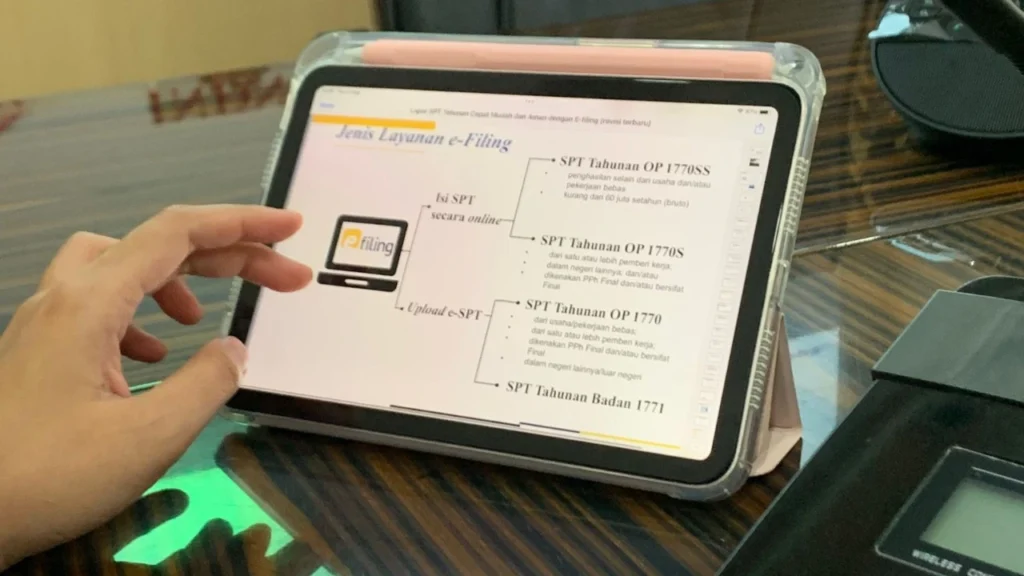
SPT 1771 consists of a main form and six mandatory attachments in accordance with PER-19/PJ/2014.
Attachment I
Contains the commercial financial statements and fiscal reconciliation. This is where fiscal corrections are made to calculate taxable net income.
Attachment II
Details of cost of goods sold and operating expenses.
Attachment III
Domestic tax credits, including Income Tax Articles 22, 23, and 26.
Attachment IV
Final income and non-taxable income.
Attachment V
List of shareholders, capital structure, and management.
Attachment VI
Affiliated transactions and special relationships.
All figures must be consistent with audited financial statements, if required. Data consistency is crucial, as the Directorate General of Taxes’ system is now digitally integrated.
Read Also: Requirements, Deadlines, and How to File the Corporate Annual Tax Return
Required Documents for Filing
Before completing SPT 1771, you need to prepare:
- Corporate NPWP
- Income statement and balance sheet
- Withholding tax slips (Form 1721)
- Tax payment receipts
- Electronic certificate
Without complete documentation, the risk of fiscal correction errors and underpayment increases.
How to File SPT 1771 Online
Filing is conducted through DJP Online or the latest Coretax DJP system for the 2025 Tax Year.
General steps:
- Log in using your NPWP and password
- Select the Annual Corporate Income Tax Return menu
- Create a draft of SPT 1771
- Complete the main form and Attachments I–VI
- Perform verification
- Submit and save the Electronic Receipt (BPE)
The system now automatically pulls data from monthly tax returns, making consistency between monthly and annual reporting essential.
Read Also: The Difference Between Monthly and Annual Tax Returns: A Taxpayer’s Guide
Challenges in Completing SPT 1771
Many business entities encounter difficulties with:
- Commercial and fiscal reconciliation
- Classification of deductible expenses
- Validation of tax credits
- Affiliated transactions
Even minor errors can trigger a tax audit. Therefore, technical understanding is essential, especially when performing fiscal corrections and accurately calculating Income Tax payable.
Simplify Your SPT 1771 Filing with vOffice
Understanding SPT 1771 requires careful attention and up-to-date regulatory knowledge. At vOffice, we provide tax consulting services and accounting and tax reporting services to help you ensure compliance while maintaining efficiency.
Our team assists you from fiscal reconciliation and tax credit validation to filing through the DJP or Coretax system. With professional guidance, you can focus on growing your business without worrying about tax risks.
If you want safer, more organized, and more strategic tax reporting, vOffice tax services are the right solution to simplify your process.
Contact us for a FREE consultation!
FAQ About SPT 1771
What is the difference between SPT 1771 and 1770?
SPT 1771 is for corporate taxpayers, while SPT 1770 is for individual taxpayers.
Are entities with nil tax still required to file?
Yes. Even if there is no tax payable, the tax return must still be submitted.
What is fiscal correction?
It is an adjustment to commercial profit and loss to comply with tax regulations.
When is the filing deadline?
No later than April 30 of the following year.
Can it be filed manually?
Yes, but filing through the DJP online system is strongly recommended.